Recursive Language Models: Why Your AI Agent Forgets
Your AI agents degrade as context grows. Recursive Language Models from MIT offer a different approach — here is when to consider it and when to wait.
Product updates, model launches, and practical insights on open source AI infrastructure in Europe.
Your AI agents degrade as context grows. Recursive Language Models from MIT offer a different approach — here is when to consider it and when to wait.
In the day-to-day work of developers, AI-assisted coding has mostly meant autocomplete up until now. A developer wrote code, and the assistant suggested the next line or function. Today, the center of gravity has moved to coding agents. This article maps the CLI-based AI agent landscape and explains what separates the main categories.
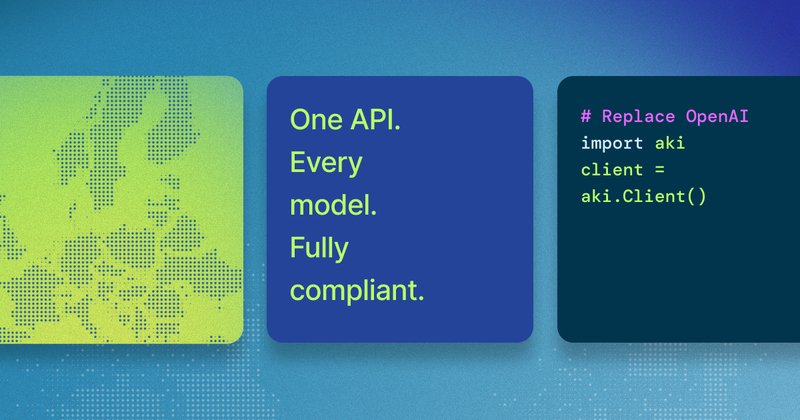
Access curated open-weight AI models on European infrastructure through an OpenAI-compatible API, without taking on the operational burden of self-hosting. Here is how AKI.IO fits that stack, and which tradeoffs to evaluate before migrating.
Moritz Gehrke is a member of Company Consulting Team e.V., Berlin’s student consulting organization. At CCT, he works on tech projects that connect modern AI tools with real organizational needs, with a focus on usable, privacy-aware systems in practice. A practical example of how a student consulting organization turned internal documents into a searchable AI knowledge base in just a few steps, using Open WebUI and the AKI.IO API on European infrastructure.
Let’s be honest: Europe did not win the race for general artificial intelligence. The United States and China are competing for dominance over frontier models — and with them, technological power.
Agentic AI is moving beyond chat into systems that can read files, edit code, call tools, browse the web, run terminal commands, and complete work across multiple steps.
A European AI API for teams that want EU-hosted inference with curated open-weight and open-source models such as Qwen, MiniMax, GPT-OSS, Llama, Apertus, Ministral, Flux.2, and more. Integrate through OpenAI- and Anthropic-compatible interfaces without self-hosting GPU infrastructure.
We use essential cookies to make this website work.
With your consent, we also use non-essential analytics cookies to understand how the website is used and improve user experience.
You can accept, reject, or change your choice at any time in Settings: Just click on "Cookie Preferences" in the footer. See our Cookie Policy for details.
We use cookies to provide you with the best experience on our website.
We use essential cookies to make this website work.
We use non-essential cookies to understand how the website is used.