How Berlin´s CCT Built an Knowledge Assistant with Open WebUI
Table of Contents
High-turnover organizations do not just lose people. They risk losing project knowledge, internal processes, and the practical experience that accumulates over time. That challenge is especially relevant for student organizations, where members regularly join, contribute, and move on.
The mission: Preserve 30 years of knowledge
At Company Consulting Team e.V. that challenge is very real. Over 30 years, the team of students from all major universities in Berlin has built up knowledge across hundreds of projects, internal guides, and shared documentation. The question was how to make that knowledge easier to access to preserve organizational memory in a form that new members can actually use. The goal was to create a knowledge chat as a practical internal system that helps transfer knowledge across generations of consultants while staying efficient, affordable, and privacy-aware.
How-To: Detailed Project Description
"Company Consulting Team e.V. (CCT) is Berlin’s leading student consulting organization, and as is typical for all student consulting organizations, turnover is high. Nevertheless, the accumulated knowledge from more than 30 years, the experience from nearly 600 external projects, and the culture are meant to be preserved.
For that reason, the task for us as JunITer, the specialized IT unit of CCT, was to use our technical expertise to create a suitable AI solution for this.
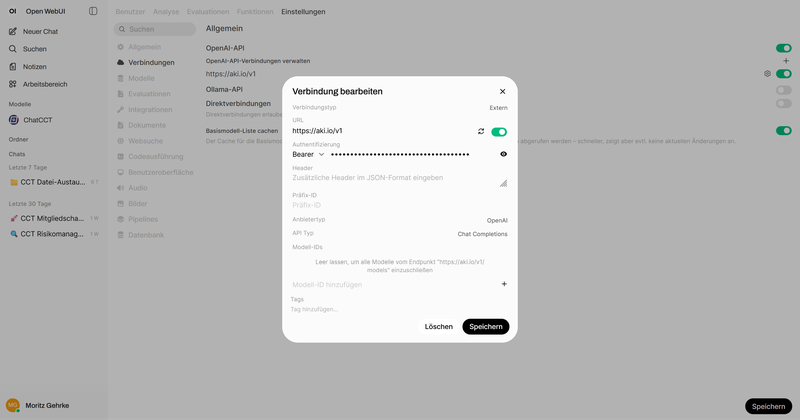
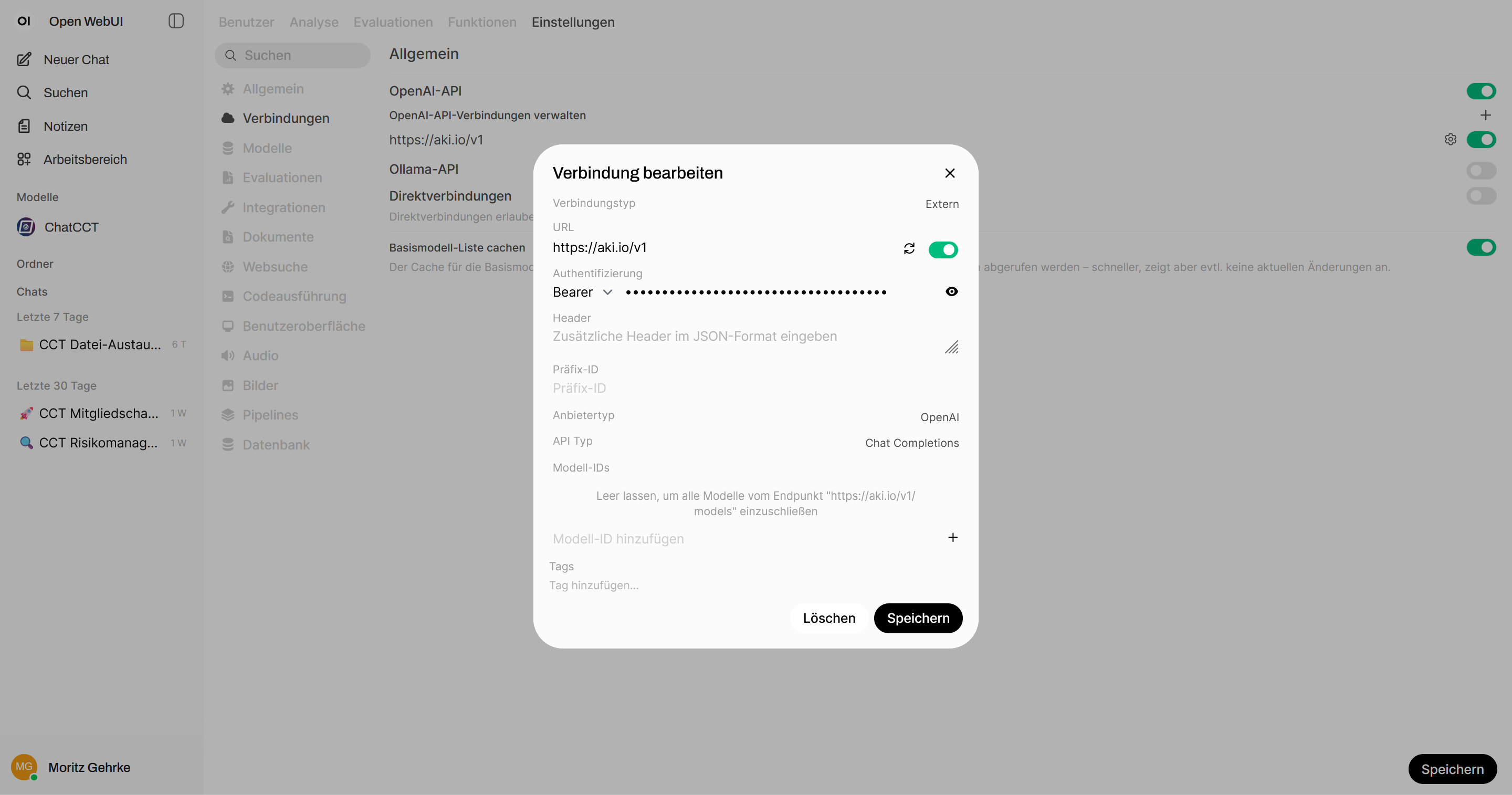
On our server, we were able to pull and start the Docker image of Open WebUI (OWUI) with just a few commands. Connecting it to the OpenAI-compatible API of AKI.IO is very easy: enter the URL and key, and that is it.
AKI.IO hosts all models exclusively on European, high-performance, and GDPR-compliant servers, which is a decisive factor for our data-sensitive environment.
Through the retrieval-augmented generation pipeline integrated into OWUI, we were able to directly connect our cross-source knowledge base, including project documentation, guides, and our internal wiki - though for our pilot, this is still a static resource that was loaded once into the OWUI workspace.
An embedding model - we opted for the German-optimized aari1995/German_Semantic_STS_V2 - converts our knowledge into vectors that are compared with the vector of the user’s query.
OWUI already provides a mature RAG prompt template that includes important principles such as grounding (refer only to the context), attribution (cite in this format [1]), and handling missing information (if you cannot answer the question, say so). We customized this to match our knowledge and supplemented it with a system prompt ("You are the CCT assistant and only provide answers related to the CCT [...]").
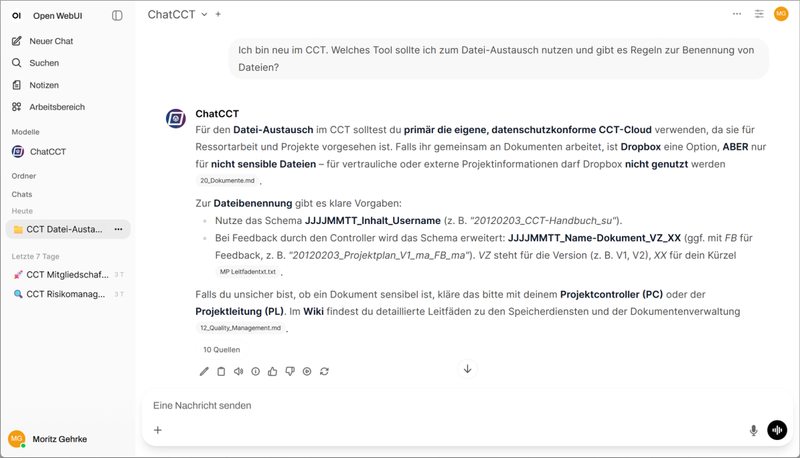
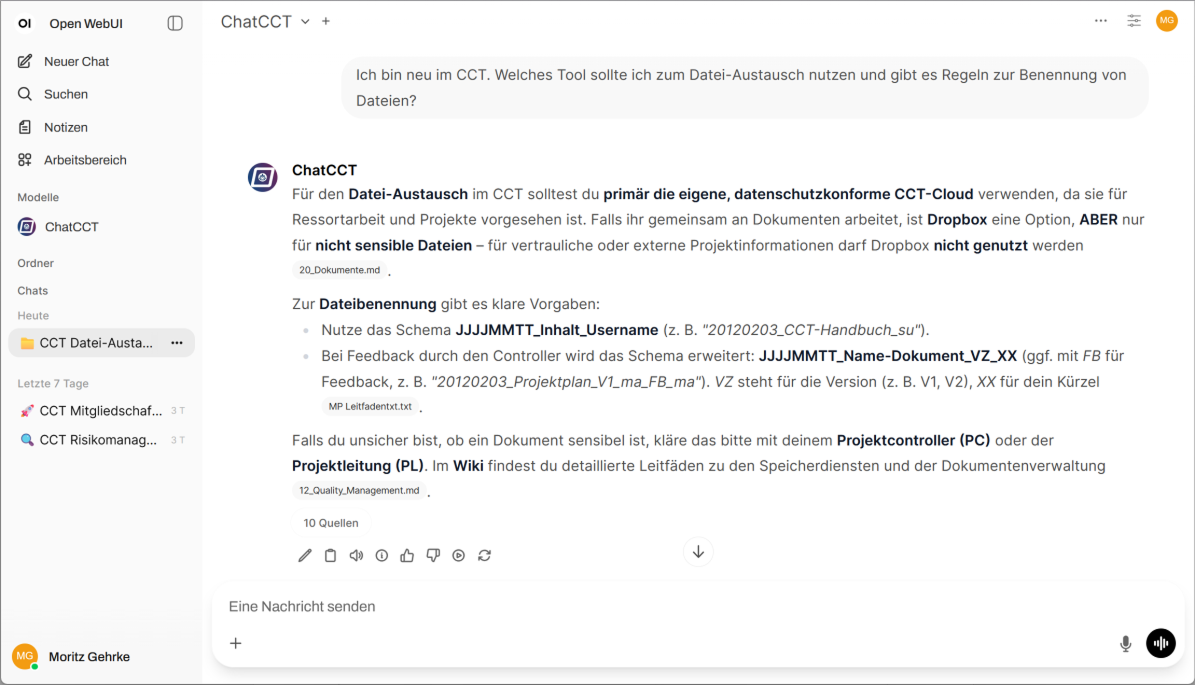
For the actual text generation, we selected Ministral 3 14B from the French startup Mistral AI, which is provided through AKI.IO. This allows CCT members to receive contextualized answers in chat and retrieve the accumulated knowledge interactively.
Another advantage is AKI.IO’s token-based billing. The dashboard shows consumption in real time, allowing us as a nonprofit organization to monitor our limited budget precisely, with no fixed price, only pay per use.
In this way, we created a powerful, cost-efficient, and privacy-compliant knowledge management tool for CCT that preserves our 30-year legacy in a sustainable way."
Verdict: Simple and fast!
This project also shows a broader point. Powering an AI project does not have to mean building everything yourself. If your stack already supports OpenAI-compatible connections, getting started can be as simple as changing the endpoint, adding an API key, and connecting the right model and knowledge base.
With Open WebUI and AKI.IO, CCT found a practical way to preserve organizational knowledge on European infrastructure.
More articles
Introducing AKI.IO: The European AI API for Model Inference
A European AI API for teams that want EU-hosted inference with curated open-weight and open-source models such as Qwen, MiniMax, GPT-OSS, Llama, Apertus, Ministral, Flux.2, and more. Integrate through OpenAI- and Anthropic-compatible interfaces without self-hosting GPU infrastructure.
Agentic AI in Europe: What Teams Should Get Right Early
Agentic AI is moving beyond chat into systems that can read files, edit code, call tools, browse the web, run terminal commands, and complete work across multiple steps.
The AKI.IO Launch Manifesto
Let’s be honest: Europe did not win the race for general artificial intelligence. The United States and China are competing for dominance over frontier models — and with them, technological power.